Ask ten crocheters how to price a beanie and you'll hear "materials × 3", "materials plus $10", and "whatever the other shops charge". The real problem with crochet and knitting is that time dwarfs materials. A hat might use $8 of yarn and three hours of work. Any formula that starts from materials alone will underpay you, and any formula that pays a full wage for every hour can produce prices nobody will pay.
This guide gives you a way through: calculate the full cost honestly, then use your effective hourly rate to decide what to make, how to price it and when to say no.
Step 1: Yarn cost, per gram, not per skein
Weigh your finished piece (or the yarn left over) and cost the yarn by weight:
Yarn cost = (skein price + shipping share) ÷ skein grams × grams used
Example: a 100 g skein at $7.99, the beanie uses 85 g.
- Per gram: $7.99 ÷ 100 = $0.0799
- 85 g × $0.0799 = $6.79
Should you charge for the whole skein instead? If the leftover 15 g goes into scrap projects you sell, cost by weight. If it sits in a bag forever, charge the whole skein ($7.99). Be honest about which one you are. In the example below we charge the full skein, because a single 15 g leftover rarely gets used.
Step 2: Notions and packaging
- Faux-fur pom-pom: $1.20
- Sewn-in brand label: $0.30
- Tissue, bag and thank-you card: $0.50
- Overhead share (hooks, pattern licenses, Etsy renewals, photos): $0.40
Materials + overhead for the beanie: $7.99 + $1.20 + $0.30 + $0.50 + $0.40 = $10.39
Step 3: Time yourself properly
Use a timer, not memory. Most makers underestimate by 30–50%. Include:
- making the piece (from first chain to last stitch),
- finishing: weaving in ends, sewing on the pom-pom, blocking,
- photographing, listing and packing (spread across the items you make).
Our beanie takes 3 hours in total.
Step 4: The "full wage" price
At a modest $15/hour:
- Labor: 3 h × $15 = $45
- Full cost: $10.39 + $45 = $55.39
Add a 20% profit margin for the business (separate from your wage) and you're at about $66. That is the honest price of a hand-crocheted beanie that takes three hours. It's also more than most buyers expect to pay, and that's the crochet pricing dilemma in one number.
Step 5: Work backwards to your effective hourly rate
Instead of arguing with the full-wage number, look at what different prices actually pay you per hour after materials and fees. On Etsy, fees are roughly 9.5% + $0.45 per order (listing, transaction and payment processing; check your country's rates and Offsite Ads).
Effective hourly rate = (price − materials − fees) ÷ hours
| Beanie price | Etsy fees | Left after materials ($10.39) and fees | Per hour (3 h) |
|---|---|---|---|
| $35 | $3.78 | $20.84 | $6.95 |
| $45 | $4.73 | $29.89 | $9.96 |
| $58 | $5.96 | $41.65 | $13.88 |
This table changes the conversation. At $35 you're working for under $7 an hour. At $58 you're close to the $15 you wanted. Now you can make a decision instead of a guess.
Step 6: Compare products by hourly rate, not by price
Here is a second item: a small amigurumi (about 1.5 hours) with $3.10 of yarn, safety eyes, stuffing and packaging, selling for $28.
- Fees: 9.5% × $28 + $0.45 = $3.11
- Left: $28 − $3.10 − $3.11 = $21.79
- Per hour: $21.79 ÷ 1.5 = $14.53
The amigurumi earns over twice as much per hour as the $35 beanie, even though it's the cheaper item. When you look at your range this way, the decisions get easy:
- Push the products with a high hourly rate. Feature them, make more variants, photograph them better.
- Raise or retire the low ones. If a blanket pays $4/hour, price it as a premium commission or stop listing it.
- Speed up the slow ones. Simpler stitch patterns, chunkier yarn or a smaller size can cut an hour from a design.
How to make a higher price acceptable
If the honest price is above what your current buyers pay, you have options beyond discounting your time:
- Better yarn, said out loud. Merino, alpaca or hand-dyed yarn justifies a higher price, and buyers understand it. Name the fibre in the title.
- Made-to-order and custom colors. Personalisation supports a premium and removes unsold stock.
- Gift positioning. A well-photographed beanie in a gift box sells as a gift, not as a commodity hat.
- Sell the pattern too. For designs you created, a PDF pattern turns three hours of work into something you can sell many times.
- Choose your channel. Craft fairs, local boutiques and your own site often support higher prices than marketplace search, where buyers compare dozens of listings side by side.
Knitting works the same way
Everything above applies to knitting: yarn by weight, notions, time, fees, effective hourly rate. Knitting is often slower per item than crochet, so the hourly-rate comparison matters even more. Socks and sweaters rarely pay well at market prices. Hats, headbands and small accessories in chunky yarn usually do better.
Pricing commissions
For custom orders, quote from the full-wage price, not your shop price:
- Agree the yarn and size first and price the yarn at full skeins (you'll be buying them).
- Estimate hours generously and add 20% for changes and back-and-forth.
- Take a deposit that at least covers the yarn.
- Put the price in writing with what's included (one revision, shipping, gift wrap).
Common crochet pricing mistakes
- "Materials × 3." With $8 of yarn and 3 hours of work, that's $24, or about $3 an hour after fees.
- Not timing the finishing. Weaving in ends and sewing parts on can be a third of the total time.
- Ignoring fees. On a $35 sale, Etsy fees are almost $4, and Offsite Ads can take more.
- Pricing by the hour you wish you worked. If you're still learning a pattern, price for the time it takes you once you know it, and treat the first few as practice.
Let a spreadsheet do the sums
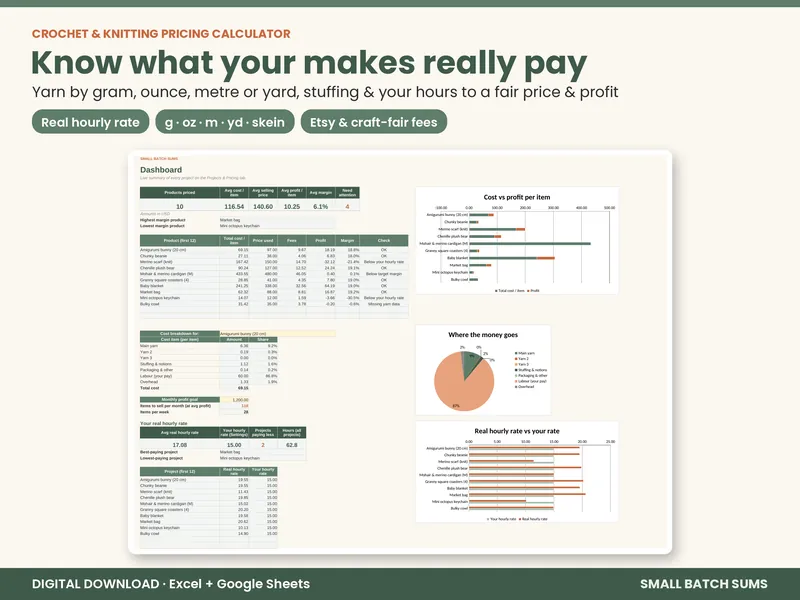
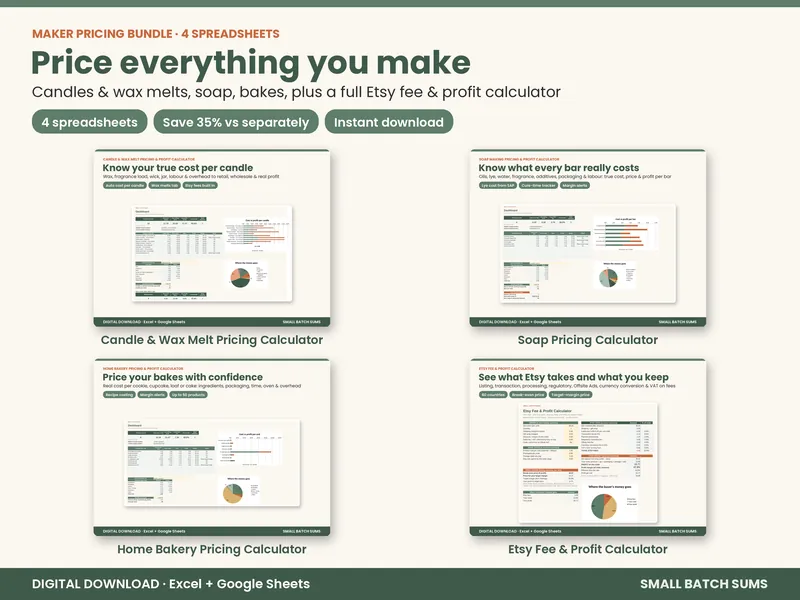
Our Crochet & Knitting Pricing Calculator does all of this for every item in your shop: yarn cost by weight, notions, time, fees, suggested price and the hourly rate each item really pays you. It's also included in the Maker Pricing Bundle.